Is There a Problem With Eggs Again?
The truth about eating eggs
(Epitome credit:
Getty Images
)
Are eggs helpful to our wellness… or a cause of heart disease? BBC Future examines the testify.
A
As many countries urge populations to stay at home, many of us are paying more attention to our diets and how the food we eat can back up our health. To aid sort out the fact from the fiction, BBC Future is updating some of our virtually pop nutrition stories from our annal.
Our colleagues at BBC Proficient Food are focusing on practical solutions for ingredient swaps, nutritious storecupboard recipes and all aspects of cooking and eating during lockdown.
If in that location was such a thing as a perfect food, eggs would be a contender. They're readily bachelor, easy to cook, affordable and packed with protein.
"The egg is meant to exist something that has all the right ingredients to grow an organism, so plain it'southward very nutrient dumbo," says Christopher Blesso, acquaintance professor of nutritional science at the University of Connecticut in the US.
Eating eggs alongside other food can assistance our bodies absorb more vitamins, too. For example, one written report institute that adding an egg to salad can increase how much vitamin E we get from the salad.
Simply for decades, eating eggs has as well been controversial due to their high cholesterol content – which some studies take linked to an increased risk of heart affliction. 1 egg yolk contains around 185 milligrams of cholesterol, which is more than than half of the 300mg daily amount of cholesterol that the US dietary guidelines recommended until recently.
Additionally, in that location have been scientifically unsupported claims the eggs can baby-sit confronting coronavirus, or that they have even been responsible for its outbreak. There has fifty-fifty been one outlandish theory that spitting in an egg before cooking it creates antibodies which can guard confronting the disease. (There'due south no evidence to support this.)
Does that mean eggs, rather than being an ideal food, might actually be doing us impairment?
You might also similar:
• Can chicken soup cure the common cold?
• Are you eating enough salt?
• How much water should you drink a solar day?
Cholesterol, a xanthous fat produced in our liver and intestines, tin can be found in every one of our body's cells. We usually think of information technology as "bad". Simply cholesterol is a crucial building cake in our prison cell membranes. It also is needed for the trunk to make vitamin D, and the hormones testosterone and oestrogen.
We produce all the cholesterol we demand on our own, but it'southward also found in animate being produce nosotros consume, including beef, prawns and eggs, equally well as cheese and butter.
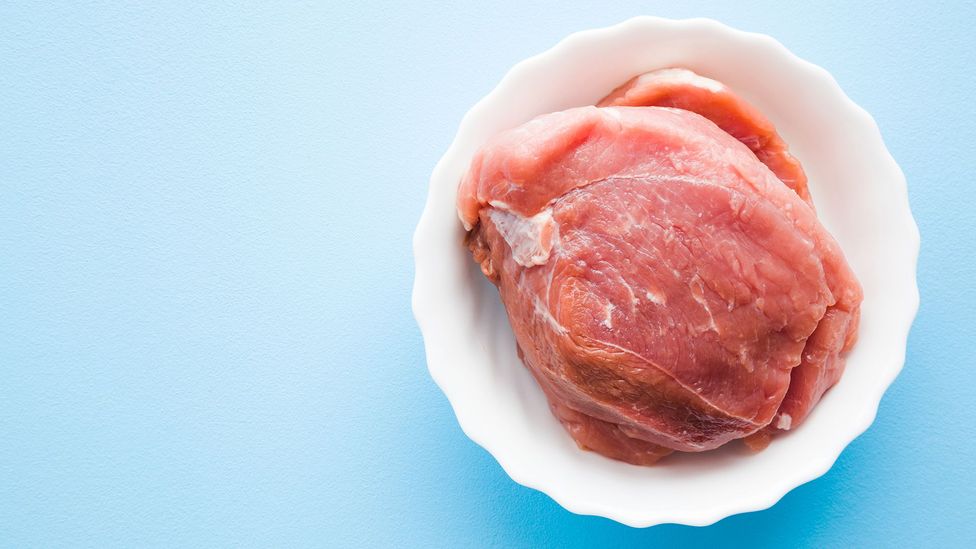
Cholesterol is establish in fauna products similar beef besides as eggs (Credit: Getty Images)
Cholesterol is transported around our body by lipoprotein molecules in the blood. Every person has a unlike combination of various types of lipoproteins, and our individual make-up plays a role in determining our risk of developing heart disease.
Depression-density lipoprotein (LDL) cholesterol – referred to as "bad" cholesterol – is transported from the liver to arteries and body tissues. Researchers say that this can result in a build-up of cholesterol in the blood vessels and increase the risk of cardiovascular disease.
Simply researchers haven't definitively linked consumption of cholesterol to an increased risk of cardiovascular illness. As a consequence, US dietary guidelines no longer have a cholesterol restriction; nor does the Uk. Instead, emphasis is placed on limiting how much saturated fat nosotros eat, which can increase the risk of developing cardiovascular disease. Foods containing trans fats, in particular, increase our LDL levels. Although some trans fats occur naturally in animal products, most are made artificially and are establish in highest levels in margarines, snacks, and some deep-fried and baked foods, such as pastry, doughnuts and cake. (Read more about whether diets encouraging people to eat more saturated fatty are salubrious.)
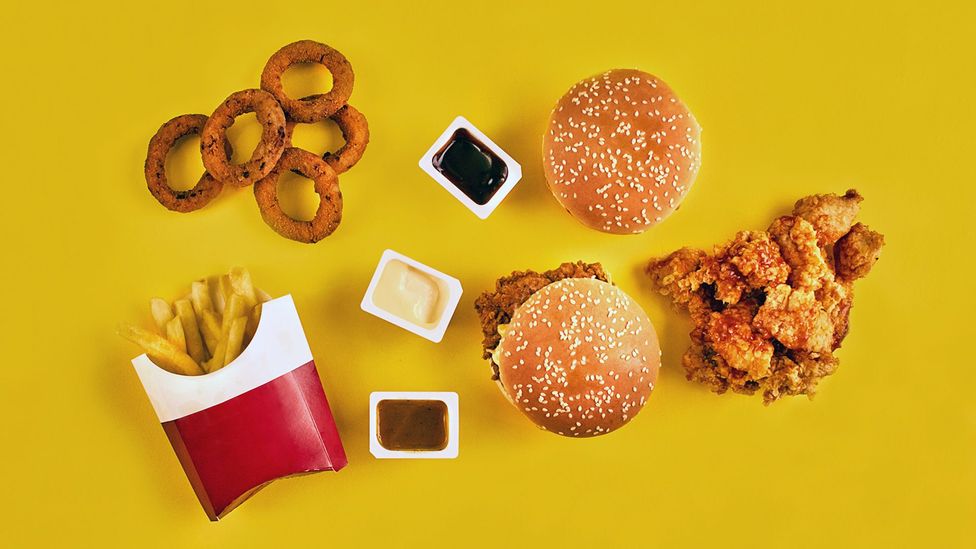
Some deep-fried foods, which incorporate trans fats, can increase our LDL (or "bad") cholesterol levels (Credit: Getty Images)
Meanwhile, forth with prawns, eggs are the only food high in cholesterol that are depression in saturated fat.
"While the cholesterol in eggs is much college than in meat and other animal products, saturated fat increases claret cholesterol. This has been demonstrated by lots of studies for many years," says Maria Luz Fernandez, professor of nutritional sciences at the Academy of Connecticut in the U.s.a., whose latest enquiry found no relationship between eating eggs and an increased take a chance of cardiovascular disease.
The truth about eating eggs
The word on the health effects of eggs has shifted partly because our bodies can compensate for the cholesterol we consume.
"There are systems in identify so that, for most people, dietary cholesterol isn't a problem," says Elizabeth Johnson, research associate professor of nutritional sciences at Tufts Academy in Boston, US.
In a 2015 review of 40 studies, Johnson and a team of researchers couldn't discover any conclusive testify on the relationship betwixt dietary cholesterol and middle illness.
"Humans accept expert regulation when consuming dietary cholesterol, and volition make less cholesterol themselves," she says.
Cholesterol is harmful when it is oxidised – simply the antioxidants in eggs foreclose that process from happening (Credit: Getty Images)
And when information technology comes to eggs, cholesterol may pose even less of a health risk. Cholesterol is more harmful when oxidised in our arteries, simply oxidisation doesn't happen to the cholesterol in eggs, says Blesso.
"When cholesterol is oxidised, information technology may be more inflammatory, and at that place are all kinds of antioxidants in eggs that protect it from beingness oxidised," he says.
Also, some cholesterol may actually exist practiced for us. High-density lipoprotein (HDL) cholesterol travels to the liver, where it's broken downwards and removed from the body. HDL is thought to have a protective issue against cardiovascular disease by preventing cholesterol from building upwardly in the claret.
"People should be concerned about cholesterol that circulates in their blood, which is the one that leads to heart disease," says Fernandez.
What matters is the ratio of HDL to LDL in our bodies, as elevated HDL counteracts the effects of LDL.
Withal, while most of us are able to buffer the cholesterol we consume with the cholesterol we synthesise in our livers, Blesso says around a third of us volition experience an increment in claret cholesterol past 10% to 15% later on consuming it.
Trials have institute that lean and healthy people are more than likely to see an increase in LDL after eating eggs. Those who are overweight, obese or diabetic will run across a smaller increase in LDL and more HDL molecules, Blesso says. So, if you're healthier to begin with, eggs potentially could have a more negative effect than if you're overweight – but if you lot're healthier, you lot're also more likely to have good HDL levels, then an increase in LDL probably isn't very harmful.
One written report found that an boosted one-half egg per day was linked to a higher risk of middle disease... (Credit: Getty Images)
Research published earlier this twelvemonth, though, challenged the recent consensus that eggs pose no harm to our health. Researchers looked at data from 30,000 adults followed for an average of 17 years and establish that each boosted half an egg per solar day was significantly linked to a college run a risk of heart affliction and death. (They controlled for the subjects' diet patterns, overall health and concrete activity to endeavour to isolate the effects of eggs.)
"Nosotros institute that, for every additional 300mg cholesterol person consumed, regardless of the food it came from, they had a 17% increased risk of cardiovascular affliction, and 18% increased risk of all-cause mortality," says Norrina Allen, i of the study's authors and associate professor of preventive medicine at Northwestern University in Illinois, US.
Y'all might besides like:
• How meal timings bear upon your waisteline
• Is breakfast the most important repast of the day?
• Why humans accept evolved to drinkable milk
"We also establish that each one-half egg per twenty-four hours led to a 6% increased risk of heart illness and 8% increased take a chance of mortality."
Despite the study being one of the largest of its kind to address this specific relationship between eggs and center disease, it was observational, giving no indication of cause and event. Information technology besides relied upon a single ready of self-reported data – participants were asked what they ate over the previous month or year, and then followed up their wellness outcomes for up to 31 years. This means the researchers only got a single snapshot of what the participants were eating, even though our diets can modify over time.
…just other studies have found that eggs are associated with a lower chance of heart disease (Credit: Getty Images)
And the written report conflicts with by results. Numerous studies suggest eggs are skillful for heart health. One previous analysis of half a million adults in China, published in 2018, even found the exact reverse: egg consumption was associated with lower risk of middle disease. Those who ate eggs every mean solar day had an 18% lower risk of death from heart disease and 28% lower risk of stroke decease compared to those who didn't eat eggs.
Like the previous study, it too was observational – meaning it's impossible to tease out cause and result. (Exercise healthier adults in China simply eat more eggs, or do the eggs make them healthier?). That, of course, may be a large part of the defoliation.
Good egg
While these studies have reignited the debate on the impact of cholesterol in eggs on our health, we practise know some ways in which eggs could bear on our take a chance of illness.
Ane mode is through a chemical compound in eggs called choline, which may help protect united states confronting Alzheimer's disease. It too protects the liver. (Find out if eggs are a good way of stopping a hangover.)
Choline, which is found in eggs, may protect us confronting Alzheimer's disease (Credit: Getty Images)
But it may have negative effects, too. Choline is metabolised by gut microbiota into a molecule called TMO, which is then absorbed into people's livers and converted to TMAO, a molecule associated with an increased risk of cardiovascular disease. Blasso has wondered if eating a lot of choline from eggs could lead to elevations of TMAO: he found studies where people were observed to take elevated TMAO levels up to 12 hours after eating eggs.
Research measuring egg consumption and TMAO has so far only found transient increases in TMAO. However, TMAO is measured as a marker for heart disease just at a baseline level, which can exist detected when people are fasting. Blasso likens this to how our blood sugar levels increase temporarily afterward eating carbohydrates, simply elevated blood sugar levels are only associated with diabetes when these levels are continuous.
This may be considering when we eat eggs, nosotros might merely get choline's benign effects, he says.
"The problem is when, instead of being absorbed into the blood, choline continues to the large intestine, where it can become TMA and and so TMAO," says Fernandez.
"But in eggs, choline is absorbed and doesn't become to the large intestine, then it doesn't increase the chance of heart illness."
Meanwhile, scientists are beginning to understand other health benefits of eggs. Egg yolks are i of the all-time sources of lutein, a pigment that has been linked to meliorate eyesight and lower risk of heart illness, for example.
Egg yolks are an excellent source of lutein, which has been linked to amend eyesight (Credit: Getty Images)
"There are two types of lutein establish the retina of the eye, where information technology can protect the retina from lite impairment by working as a blue calorie-free filter, as exposure to calorie-free makes the eye deteriorate," says Johnson.
While researchers are a long way from understanding why eggs affect us differently, the vast majority of recent research suggests they pose no chance to our health, and are much more likely to provide health benefits.
However, having eggs for breakfast every day probably isn't healthiest option, either – at least as it'southward recommended we take a varied diet… rather than put all our eggs in 1 basket.
Join one 1000000 Time to come fans past liking united states on Facebook , or follow us on Twitter or Instagram .
If you liked this story, sign upward for the weekly bbc.com features newsletter , called "The Essential List". A handpicked selection of stories from BBC Future, Culture, Capital, and Travel, delivered to your inbox every Friday.
Source: https://www.bbc.com/future/article/20190916-are-eggs-good-for-you
0 Response to "Is There a Problem With Eggs Again?"
Post a Comment